
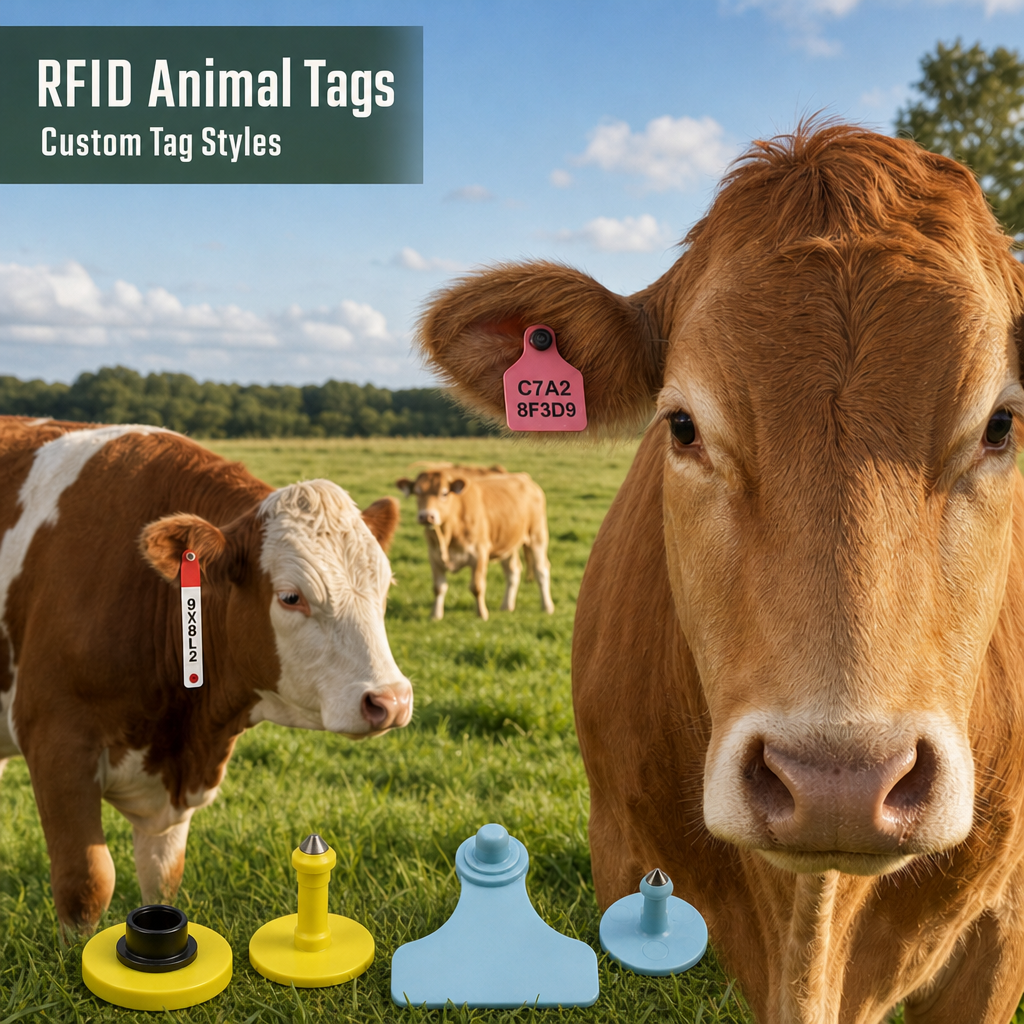
An RFID animal ear tag is a small electronic identification device attached to the ear of livestock, pets, or wildlife. It combines a visual ID number with a radio-frequency identification (RFID) chip, allowing each animal to be identified automatically and uniquely — even at a distance and without line of sight.
Unlike printed or laser-engraved tags that rely on human reading, RFID ear tags store a unique digital ID that can be captured by a handheld or fixed reader in seconds. This makes them the foundation of modern animal identification, traceability, breeding management, and disease-control programs worldwide.
RFID ear tags are used across three broad sectors:
Livestock farming — cattle, sheep, goats, horses, camels, and pigs
Pet management — dogs, cats, and other companion animals
Poultry and wildlife — poultry flocks, zoo animals, and wild-animal research programs
How Do RFID Ear Tags Work?
Each ear tag contains three core components:
An RFID chip — stores a unique identification number and, in some cases, rewritable data.
A copper antenna coil — receives energy from the reader and transmits the ID back.
An encapsulation body — protects the chip and coil from water, dust, UV exposure, and mechanical impact. When a reader emits a radio signal, the tag's coil captures the energy, powers up the chip, and the chip replies with its stored ID. No battery is required — RFID ear tags are passive devices with a service life of many years.
Choosing the right air-interface protocol is one of the most important technical decisions when sourcing ear tags.
Practical advice: Most national livestock databases and international trade programs require FDX-B (ISO 11784/11785). If your animals will be exported or recorded in official databases, FDX-B is the safest default. HDX is preferred where maximum read reliability in harsh conditions matters most.
ICAR — the International Committee for Animal Recording — is the global authority for animal identification numbering. Under ICAR rules, every compliant RFID tag carries a unique 15-digit number.
Why ICAR certification matters:
Government tenders and official identification programs typically require ICAR-compliant tags.
It guarantees global uniqueness — no two animals in the world share the same number.
It prevents numbering conflicts when animals are exported or recorded across borders.
RFID animal ear tags are far more than a piece of plastic with a number. The right combination of FDX-B or HDX protocol, a genuine and stable chip, ICAR-certified numbering, TPU material, and IP67/IP68 two-shot molding determines whether your identification program succeeds for one season or for the animal's entire lifetime. When evaluating suppliers, look beyond price: chip authenticity, encapsulation quality, and certification integrity are the factors that protect your data — and your animals — for years to come.
Partner with a Manufacturer You Can Trust
Guangdong Xinye Intelligent Label Co., Ltd. has specialized in RFID animal identification products for nearly two decades. With a 30,000 m² production base, 20+ automated production lines, and an annual capacity of around 200 million tags, we deliver ICAR-certified RFID ear tags manufactured to international standards .Whether you need samples within 2–5 days, a flexible order quantity starting from a single unit, or OEM/ODM programs backed by 100+ patents and global certifications (CE, RoHS, REACH), our engineering team is ready to support your identification program from design to delivery.


