
RFID anti-metal tags are specially designed radio frequency identification tags that can operate reliably when attached to metal surfaces. Unlike conventional RFID labels, which may experience significant performance degradation when placed directly on metal, anti-metal RFID tags incorporate specialized materials and antenna structures to reduce metal interference.
Metal surfaces can reflect electromagnetic waves, detune RFID antennas, and affect communication between the tag and RFID reader. Anti-metal tags are engineered to overcome these challenges, making them suitable for industrial environments where metal equipment, machinery, tools, and containers need to be identified and tracked.
With the growing demand for automated identification and industrial asset management, RFID anti-metal tags are widely used in manufacturing, warehousing, logistics, transportation, and equipment tracking.
When a conventional RFID tag is attached directly to a metal surface, the metal can interfere with the tag's antenna and change its electrical characteristics. This may result in reduced reading distance, unstable communication, or complete reading failure.
RFID anti-metal tags use specialized designs to minimize these effects.
Depending on the product structure, common solutions include:
Ferrite shielding materials: Used in HF RFID tags to help isolate the antenna from metal surfaces.
Spacer materials: Create a separation layer between the antenna and metal surface.
PCB and FR4 structures: Provide a stable substrate for antenna design and industrial applications.
ABS and engineering plastic housings: Protect the RFID inlay and provide a suitable structure for mounting on metal.
Flexible anti-metal materials: Designed for curved surfaces, pipes, and equipment with irregular shapes.
These structures help maintain more stable RF performance when the tag is mounted on metal.
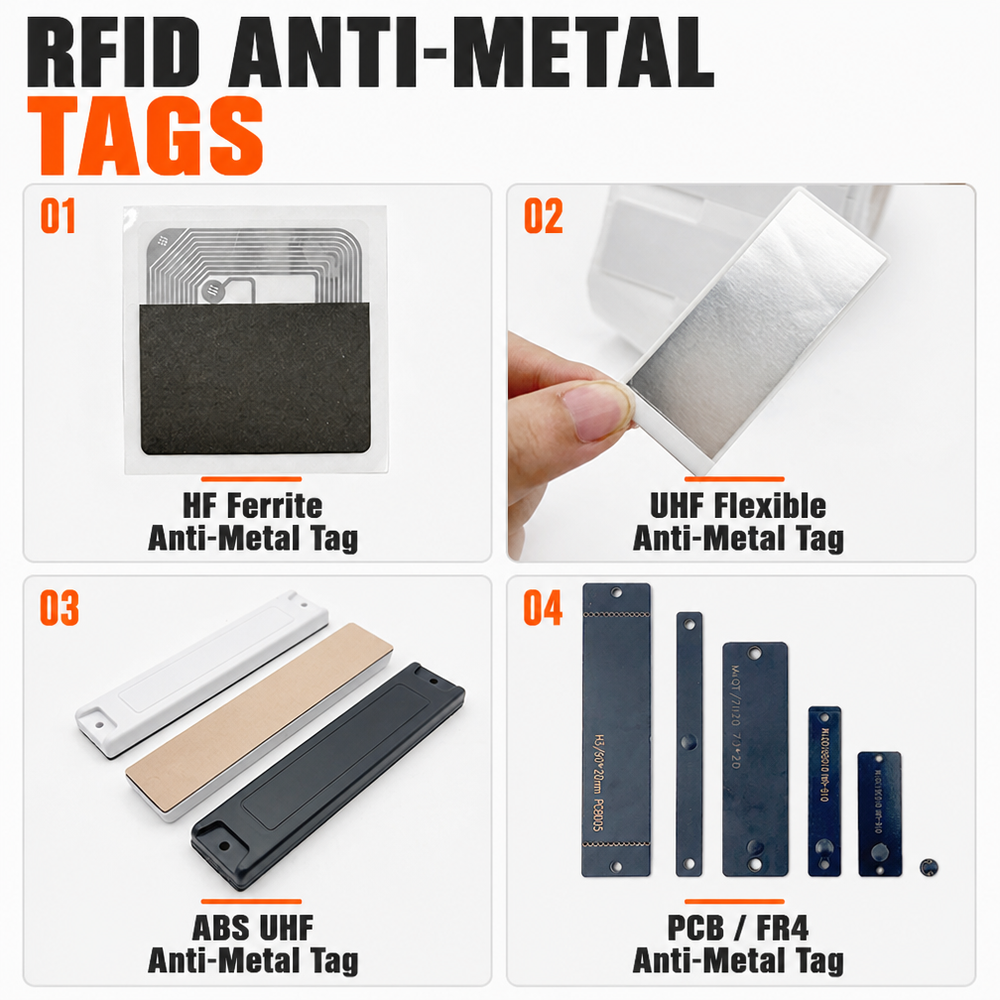
Different applications require different tag structures, operating frequencies, installation methods, and environmental resistance. The following are common RFID anti-metal tag types.
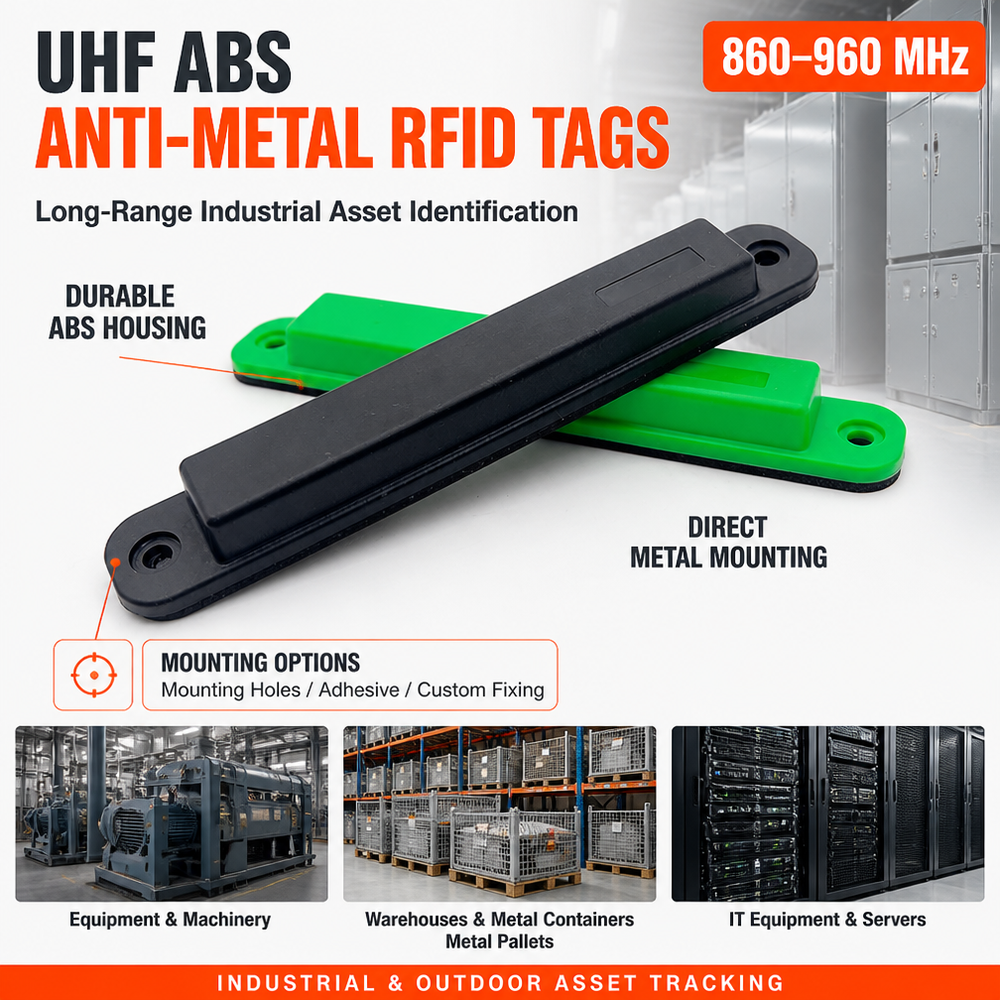
UHF ABS anti-metal tags feature a durable plastic housing and a specially designed internal antenna structure. They are suitable for applications requiring long-distance identification and industrial asset tracking.
Key Features:
Operating frequency: 860–960 MHz
Durable ABS housing
Designed for direct installation on metal surfaces
Available with mounting holes, adhesive, or customized fixing methods
Suitable for industrial and outdoor asset identification
Typical Applications:
Metal equipment tracking
Warehouse asset management
Industrial machinery identification
IT equipment and server tracking
Metal containers and pallets
Flexible anti-metal RFID tags are designed for applications where rigid tags are difficult to install. Their flexible construction allows them to fit curved or irregular metal surfaces.
Key Features:
Flexible and lightweight structure
Suitable for curved metal surfaces and pipes
Available with high-performance adhesive backing
Designed for stable identification on metal
Customizable dimensions and antenna configurations
Typical Applications:
Steel pipes and cylinders
Industrial equipment
Metal tools and components
Curved machinery surfaces
Returnable transport items
PCB RFID anti-metal tags use FR4 circuit board material as their substrate. Their rigid structure provides mechanical stability and supports customized antenna designs.
Key Features:
FR4 PCB construction
UHF frequency options, including 865–868 MHz and 902–928 MHz
Compact and rigid design
Suitable for industrial environments
Available with adhesive or mechanical mounting options
Typical Applications:
Industrial automation
Metal asset tracking
Manufacturing equipment
Tool and fixture management
Industrial logistics
HF anti-metal RFID tags typically incorporate ferrite material between the antenna and the metal surface. This helps reduce the influence of metal on the magnetic field and improves contactless communication performance.
Key Features:
Operating frequency: 13.56 MHz
Compatible chip options such as MIFARE, NTAG, and ICODE families
Ferrite shielding structure
Available in different shapes and dimensions
Suitable for short-range identification
Typical Applications:
Metal equipment identification
Access control
Industrial tool management
Metal product authentication
Electronic device identification
Selecting the right RFID anti-metal tag requires more than simply choosing a frequency. Buyers should consider the installation environment and the actual requirements of the RFID system.
1. Operating Frequency
HF (13.56 MHz): Suitable for short-range identification, access control, and industrial applications.
UHF (860–960 MHz): Suitable for longer-range identification, warehouse management, and bulk asset tracking.
2. Installation Surface
Consider whether the tag will be installed on flat metal, curved pipes, machinery, or irregular surfaces. Flexible tags are suitable for curved surfaces, while ABS and PCB tags are often selected for rigid installations.
3. Reading Distance
Reading distance depends on antenna design, chip sensitivity, reader output power, antenna polarization, mounting position, and surrounding materials.
For applications requiring long-distance reading, UHF anti-metal tags are commonly considered.
4. Environmental Requirements
Industrial applications may require resistance to temperature changes, moisture, dust, vibration, chemicals, and mechanical impact.
The tag housing, adhesive, encapsulation, and materials should be selected according to the actual working environment.
5. Mounting Method
Common installation methods include:
3M adhesive backing
Industrial high-tack adhesive
Screw mounting
Riveting
Customized mechanical fixing
Choosing the correct mounting method helps ensure long-term installation stability.
RFID anti-metal tags are becoming increasingly important in industrial digitalization and automated asset identification.
Industrial Asset Management
Manufacturers can attach RFID anti-metal tags to machinery, equipment, tools, and metal assets to improve inventory accuracy and tracking efficiency.
Warehouse and Logistics Management
RFID tags can be installed on metal containers, storage racks, pallets, and reusable transport equipment to support automated identification and inventory operations.
Manufacturing and Production Tracking
RFID anti-metal tags help identify metal workpieces, production fixtures, molds, and manufacturing equipment throughout production processes.
Oil and Gas Industry
Specially engineered industrial RFID tags can be used to identify metal pipes, drilling equipment, and other industrial assets. High-temperature, pressure, and chemical resistance must be evaluated according to the operating conditions.
IT Asset Tracking
UHF anti-metal tags can be attached to servers, computer equipment, and metal cabinets to support asset registration, inventory, and maintenance management.
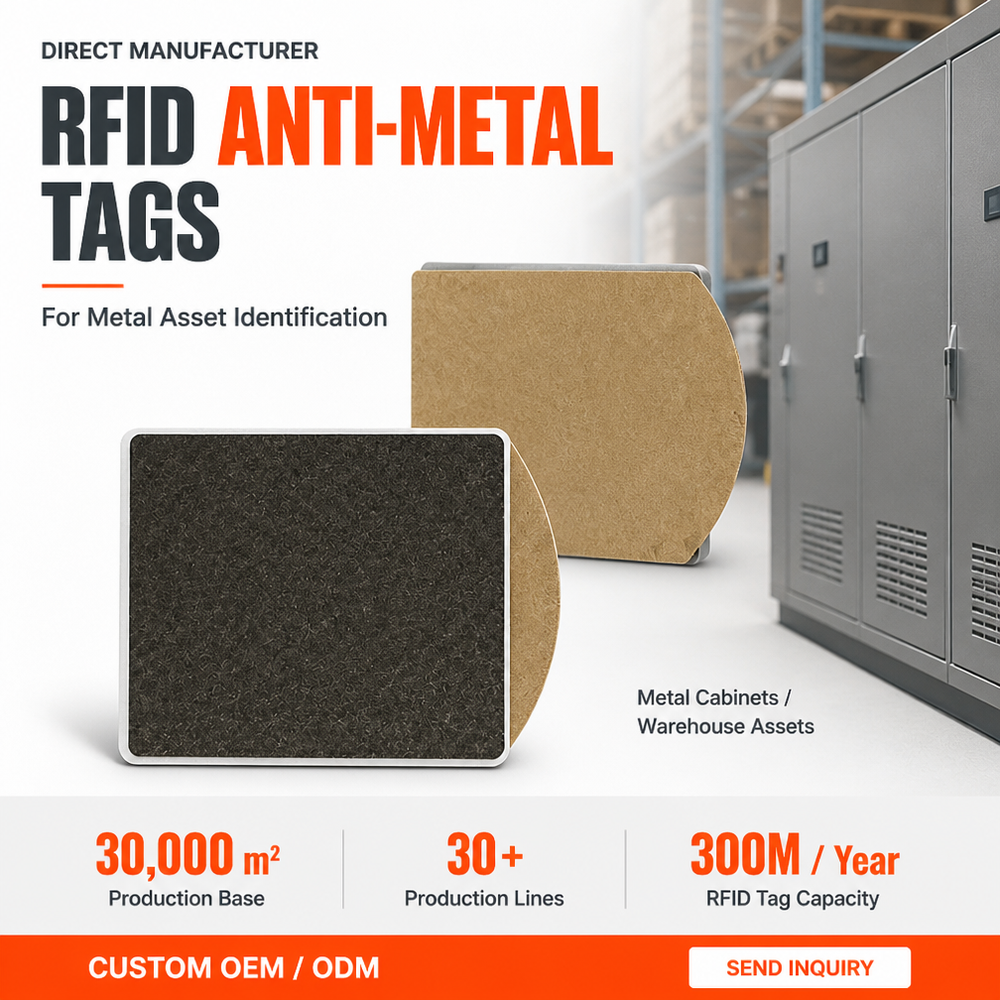
Guangdong Xinye Intelligent Label Co., Ltd. is a professional RFID tag and smart card manufacturer in China, specializing in RFID product manufacturing and customization. Our customization services cover tag dimensions, antenna design, chip selection, materials, adhesive options, printing, and product structures.
Whether you need compact RFID labels for metal equipment or durable industrial tags for asset tracking, Xinye can provide customized RFID tag products according to your project specifications.
Looking for a Reliable RFID Anti-Metal Tag Manufacturer?
Contact Guangdong Xinye Intelligent Label Co., Ltd. to discuss your frequency requirements, installation surface, chip options, dimensions, and application environment.


