
The global designer toy market is evolving rapidly. From collectible blind boxes and limited-edition figures to IP merchandise, art toys, and interactive collectibles, consumers are no longer looking for products that simply look attractive. They want authenticity, exclusivity, personalization, and engaging experiences.
As toy brands continue to explore digital innovation, RFID and NFC technology are creating new opportunities to connect physical collectibles with digital content.
By embedding a small RFID or NFC inlay inside a designer toy, collectible card, packaging, or accessory, brands can give each product a unique digital identity. With a simple tap or scan, consumers can access product information, verify authenticity, unlock exclusive content, and interact with their favorite IP characters.
This transforms traditional collectibles into connected smart products.
An RFID/NFC inlay is the core electronic component of an RFID or NFC product. It typically consists of a microchip and an antenna mounted on a substrate such as PET or paper.
Although compact and lightweight, an inlay enables wireless communication between the product and a compatible reader or NFC-enabled smartphone.
Depending on the application, different technologies can be selected:
HF RFID / NFC (13.56 MHz): Suitable for smartphone interaction, product authentication, digital content access, and collectible identification.
UHF RFID (860–960 MHz): Suitable for inventory management, warehouse tracking, bulk identification, and supply chain visibility.
For designer toys and consumer collectibles, HF NFC inlays are particularly attractive because most modern NFC-enabled smartphones can interact with them without requiring a dedicated reader.
NFC technology combined with AI enables plush toys to become interactive companions with unique personalities and conversational abilities.
How It Works: An NFC tag is embedded inside the plush toy. Users tap it with their smartphones to activate the device, connect to an app, and interact with AI-powered characters.
NFC-enabled audio toys allow children to enjoy stories, music, and educational content without screens or complicated operations.
How It Works: An NFC reader is built into the speaker base, while each toy contains an NFC tag with a unique content ID. Simply place the toy on the base to trigger the corresponding audio.
NFC helps designer toy brands protect collectible products while creating more engaging consumer experiences.
How It Works: An NFC tag is embedded inside the toy or packaging. Consumers tap it with a smartphone to verify authenticity, access digital collectibles, and unlock exclusive content.
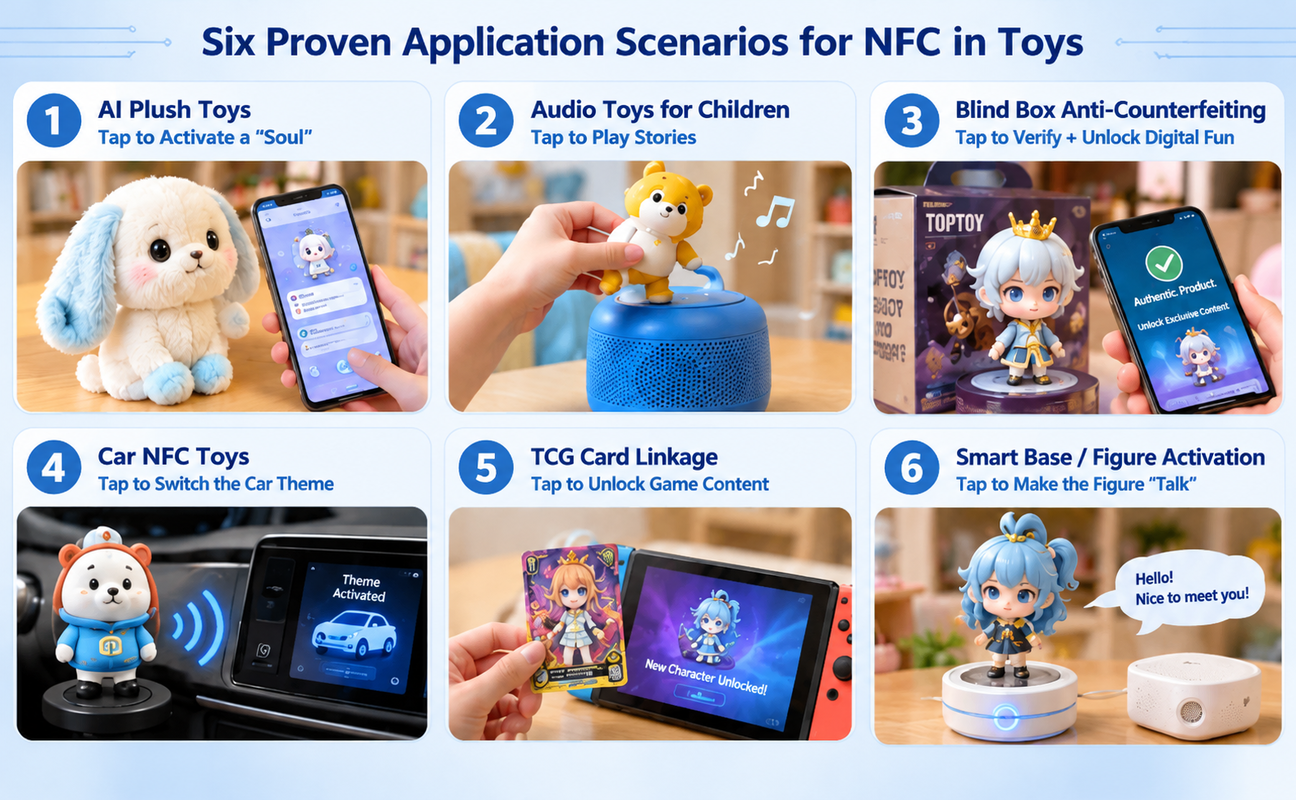
NFC-enabled automotive toys combine collectible figures with personalized in-car entertainment.
How It Works: An NFC chip is integrated into the toy, potentially combined with a magnetic mounting structure. When placed at a compatible in-car detection point, it can trigger vehicle themes, animations, or sound effects.
NFC-enabled cards connect physical collectibles with digital games and interactive entertainment.
How It Works: An NFC tag is embedded inside the card. Tapping it against a compatible reader or smartphone identifies the card and unlocks characters, special skills, or exclusive digital content.
NFC technology transforms traditional display figures into interactive smart collectibles.
How It Works: An NFC reader is built into the display base, while an NFC tag is embedded in the figure. When placed on the base, the system identifies the character and activates its corresponding voice interaction, AI dialogue, or digital content.
One of the biggest advantages of RFID/NFC inlays is their flexible integration. Depending on the toy structure and manufacturing process, inlays can be embedded into different product components.
|
Integration Position |
Recommended Application |
|
Inside PVC / ABS toy figures |
Digital identity and authentication |
|
Inside collectible cards |
Digital certificates and IP interaction |
|
Inside blind-box packaging |
Anti-counterfeiting and product information |
|
Inside product hangtags |
Brand verification and marketing |
|
Inside display bases |
Interactive character experiences |
|
Inside accessories |
Smart identification and digital rewards |
For compact designer toys, antenna size, installation position, surrounding materials, and reading distance should all be considered during product design.
Metal components require special attention because they can interfere with HF and UHF radio-frequency communication. Appropriate antenna design and ferrite or anti-metal structures may be necessary depending on the application.
For designer toy brands and toy manufacturers, choosing the right RFID/NFC inlay supplier is essential. A reliable inlay manufacturing partner should be able to provide flexible customization according to different toy structures and production requirements.
Guangdong Xinye Intelligent Label Co., Ltd. specializes in RFID cards and RFID labels, providing customized RFID/NFC inlay manufacturing for different industrial and commercial applications. Contact Guangdong Xinye Intelligent Label Co., Ltd. for customized HF/NFC and UHF RFID inlay manufacturing.


