
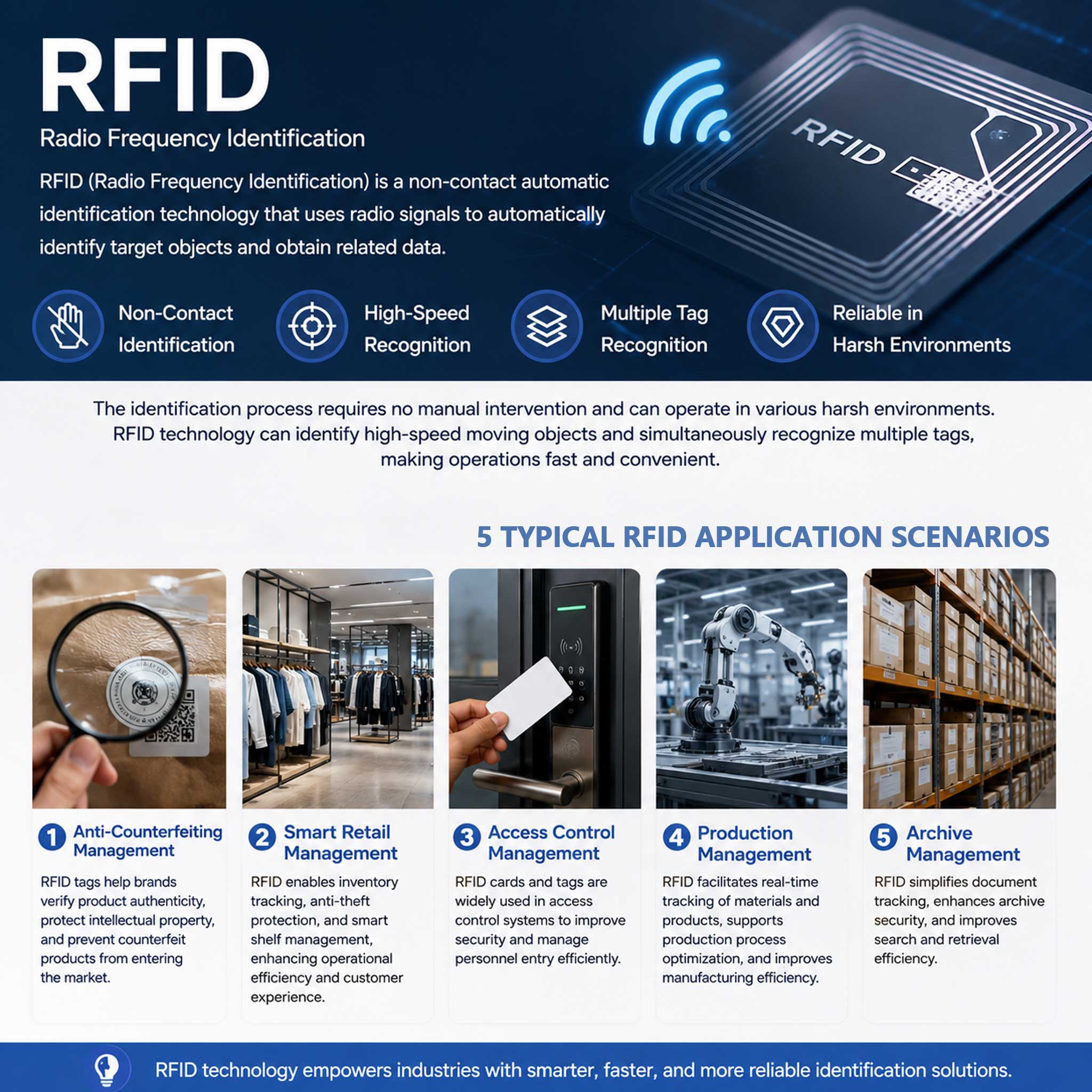
RFID (Radio Frequency Identification) is a non-contact automatic identification technology that uses radio signals to automatically identify target objects and obtain related data. The identification process requires no manual intervention and can operate in various harsh environments. RFID technology can identify high-speed moving objects and simultaneously recognize multiple tags, making operations fast and convenient. In this article, we will explore five typical RFID application scenarios that are transforming industries worldwide, including anti-counterfeiting management, smart retail management, access control management, production management, and archive management.
Scenario 1: Anti-Counterfeiting & Anti-Diversion
The fundamental implementation of anti-counterfeiting and anti-diversion systems is to assign a unique identity to each product. This identity is represented on the product through RFID anti-counterfeiting labels and simultaneously recorded in the anti-counterfeiting and anti-diversion management system. As the product continues to circulate, the system records relevant distribution information along with the product's logistics changes. If diversion occurs, the system automatically alerts the enterprise about which batch of goods was diverted at what time, enabling the enterprise to formulate appropriate solutions and effectively manage distributors.
Using NFC anti-counterfeiting platform, NFC tags are bound to product information at the factory. Customers can directly query product authenticity using NFC-enabled smartphones, providing a seamless verification experience.
Scenario 2: Unmanned Retail
Artificial intelligence applications are gradually penetrating into everyday life, making everything seem possible. Consumer scenarios are shifting to be "consumer-centric," giving rise to many new business models and scenarios.
Behind unmanned convenience stores lies big data collection, machine vision, biometric identification, credit settlement systems, and other innovative technologies. The transformation of traditional retail indicates the industry's urgent demand for new technologies and applications. In unmanned supermarkets, RFID technology enables automatic payment and post-payment exit confirmation. The hardware architecture includes strategically placed RFID inlays throughout the store to track product selection and purchase in real-time.
Scenario 3: Personnel & Vehicle Management
Personnel Management Channel: Personnel carrying UHF electronic tags embedded in PVC cards pass through access control channels. When passing through, the card triggers the reader to read the tag and uploads data to the backend server in real-time for analysis. The system identifies personnel information, determines access permissions, and records the list of authorized passers.
Vehicle Management: The system uniformly manages and registers incoming and outgoing vehicles, issues on-board electronic tags, and installs RFID reading equipment at key monitoring points. When supervisory vehicles with electronic license plates pass through monitoring channels, the identification system accurately and promptly recognizes them to complete vehicle data collection requirements.
Using wireless communication and other information technologies, the collected vehicle information is submitted to the management system to complete vehicle identity confirmation, as well as query, statistics, and dispatch functions. The application of customs port electronic license plate systems can effectively improve customs vehicle passage capacity, monitor vehicle information in real-time, prevent missed inspections, improve customs clearance efficiency, and combat smuggling activities.
Linearly polarized antennas are installed at monitoring points. When vehicles pass by, the RFID tags are read and uploaded to the backend in real-time.
Scenario 4: Production Management
Inbound & Outbound Management: Through infrared detection to determine product inbound information. For example, in a textile factory, weft yarn moves from the production workshop to the warehouse. Infrared triggers the reader to read the card, enabling real-time monitoring of product inbound and outbound information.
Workstation Management: RFID Electronic tags and pallet tags are bound to workstations. Through infrared triggering, the system achieves precise workstation tracking and management, optimizing production line efficiency and traceability.
Scenario 5: Archive Management
By attaching rfid sticker to each archive document and installing specially designed antennas in archive cabinets, the system achieves precise positioning of archives. It collects relevant information about the archives and can be extended to implement functions such as quick search, inventory, monitoring, and detection of misplaced archives.
Archive Management System Components:
1. Security Gate: Confirms the reliability of borrowed archives
2. Workstation: Handles archive borrowing and return operations
3. Card Issuer: Binds electronic tags to archives
4. Smart Archive Cabinet: Archive cabinets designed to accommodate RFID hardware


